Tuesday, 2 November 2010


The War of the Report Cards

I have shied away from tackling the Greatest Of All Time (GOAT) debate for some time because:
1> I think it’s been done to death.
2> It’s gotten to be tiresome; there’s little new under the sun to be said about the great Federer – Nadal rivalry.
3> It’s the season end and just as the players are taking a well-deserved break , so should B/R writers take a rest from this acrimonious topic.
4> I feel the other players deserve some space and time devoted to them.
But since there seems to be no abatement of interest in the subject , let me try and take another dekko at the risk of seeming repetitive.
Frankly, the whole debate seems a bit unfair to Nadal. It’s like looking at two students: one senior , the other a few years junior.One has graduated and post-graduated with honours and is doing a few extra courses just to round out his grades.The other has presented his half-term report; it is an excellent one, a fantastic one. He has outdone his senior in some respects and his trajectory has shown a sharper, upward curve.He’s even taken on a few courses that his senior deigned to tackle much later.But yet there is the feeling of incompleteness, a feeling as though the elder statesman is the favoured one because the younger man is still a work in progress.
The elder Federer had taken the world by storm, completely eclipsing the accomplishments of his predecessors in the tennis school.It’s as though the sport is now identified by Federer; the stature of both past and present players is judged against his luminescence.It’s no longer about how Federer compares to the others; it’s about how the others compare to Federer. That’s undeniable.
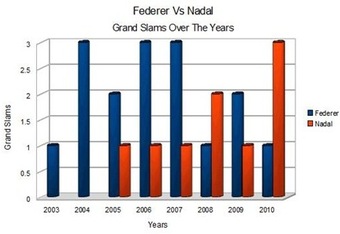
Federer won his first Grand Slam title in 2003. It was unlucky for Mark Philippoussis that it was a hungry
Federer that he met in the Wimbledon final.
Federer took his game to stratospheric levels the following year winning three of the four Slams on offer. The French Open was the only blemish in a near perfect year; he lost to Gustavo Kuerten in the third round. In hindsight, Federer will probably regret not taking his best chance for winning a French Open then. But he was not blessed (or cursed) with the gift of prescience.
Federer had an OK 2005 by his standards – losing to an inspired Safin in the Australian Open semi-final and to Nadal in the French Open semi-final. The Wimbledon and US Open titles were easily retained. Nadal won his first Grand Slam at the French Open. Patrick McEnroe had this to say about Nadal then : "Nadal is such a physical animal. Here's a kid who is 18 and he is built like a Mack truck. He has so much intensity, so much energy . . . I haven't seen a lefty hit an `off' forehand, that inside-out forehand, as well ever." Federer had seen the future in the emergence of the phenomenon from Mallorca. Rafael Nadal would be his nemesis in the years to come.
2006 and 2007 came and went and Federer went 6/8 in the Grand Slams. Nadal was dominant on the clay courts and was threatening to improve on other surfaces as well. Nadal was taking the fight to Federer challenging him twice in the Wimbledon finals. It took all of Federer’s guile to stay the course. The French Open was deemed a lost cause even before the tourney began such was Nadal’s superiority on the red courts.John McEnroe on the rivalry in 2007: "Nadal is making Federer a better player. That's all you can ask for in a rival. The best that could happen to their rivalry is what happened at Wimbledon on Sunday, with Federer winning." Sampras recognised that his record of 14 Grand Slams was under threat: "Records are meant to be broken. Roger's got all the tools. He's got the demeanour. I don't see anyone with a big enough weapon to hurt him. They're staying back and Roger is able to dictate. You just have to serve well and attack him."
 Grand Slam Time Line: Federer Vs Nadal
 2009 saw Nadal begin ominously clinching his first ever Australian Open. But the toil of the years had taken a toll on his weakened, shattered knees. At the French Open, Nadal lost for the first time in five years to Robin Soderling. Tendinitis in his knees forced him to opt out of Wimbledon. Federer used his misfortune and absence to gloss over his decline and captured his first and only French Open title equalling Pete Sampras’ record of 14 Slams. He followed it up with another Wimbledon title pushing back a battling Andy Roddick in the final. It seemed he would make it his fourth three in a year but Argentine Del Potro had other ideas in the US Open final.
2010 saw Federer start the year with a bang annexing his 16th Grand Slam. He was now at the summit and it appeared that it would only be a matter of time before he clinched his 17th and 18th. But the return of Nadal , a much improved Nadal, a resurgent Nadal, a Nadal with a point to prove, a Nadal who recognised that this was his second coming, his second chance.There was no stopping the Spanish typhoon. He swept past all with an imperiousness reminiscent of Federer at his best. The Career Slam was his by such a wide margin that there was no doubt in anyone’s mind that the Spanish ruffian was not content in resting in the shadow of the man whom he has dominated, reduced to tears and kept human when the others grovelled in abject subjugation.
 Bjorn Borg: Quit when the quitting was good!
 If Federer is battling his mortality, Nadal seems to be battling himself. His scowling countenance is a statement of how unhappy he is with his level of play on the court rather than any dislike for his opponents. But as his uncle Tony tells him --- his 70 to 80 per cent is most times better than most players’ 100 per cent.
The only doubt that lingers is about Nadal’s longevity. Nadal flirts with danger with his robust style of play.His knees need to be injected every now and then to keep the bullish Nadal going.
If we were to take lessons from the past, who could we compare Nadal to?
I can think of three greats who spring to mind: Bjorn Borg, Boris Becker and Mats Wilander.
Bjorn Borg finished with 11 Slams, 6 French Open and 5 Wimbledon. He retired at 26 because he could no longer motivate himself to keep going.
Boris Becker won his first Slam, Wimbledon, at 17. He finished with six slams, three Wimbledon, two Australian Opens and one US Open. He too played with reckless abandon much like Nadal but with much less damage to his knees. He retired in 1999 at the age of 32.
Mats Wilander notoriously faded away after achieving three Slams in 1988. Only Wimbledon eluded him that year. His motivation disappeared after that fabulous year and he preferred strumming his guitar to continuing
on the court.

Is Nadal destined to go the same way? Can he ration out his enthusiasm like his appearances this year? That is the million-dollar question.Else we will have more instances of Nadal losing early in a tournament saying : “I’m tired.”It is good for tennis and Nadal that the 2010 season is almost at an end. Even a great has to rest sometime and who more than Nadal having won three Slams on the trot. The Importance Of Being Earnest at all times is highly overrated.
For those who keenly follow the the rankings, the year ending World Tour Final is the icing on the cake. For most others, victory at the Grand Slams is the sole arbiter of greatness. The Australian Open awaits them the following year.
The tennis will continue and these two greats will re-join battle soon.
Who is to say what 2011 will bring us and these two conquistadors?
Courtesy: Bleacher Report
Facebook update

"Gracias a todos por el apoyo al evento del 22 de diciembre en Madrid. Las entradas estan ya vendidas"!!!
"Thanks to all for your help on the event in Madrid on Dec. 22nd. Sold out already"!!!
Nadal v Federer Tickets
As predicted the event sold out in quick time.
For those not able to make it remember that you can buy "Row Zero" tickets from as little as €10. All monies go direct to Fundación.
I have just purchased my "Row Zero" tickets, I am on Row 7 Seat 4 :)
Courtesy: Marca (google translation)
For those not able to make it remember that you can buy "Row Zero" tickets from as little as €10. All monies go direct to Fundación.
I have just purchased my "Row Zero" tickets, I am on Row 7 Seat 4 :)
Courtesy: Marca (google translation)
Tuesday previews
Round - up
2 tournaments in play this week, Basel & Valencia. Here is a round of yesterday's action (bear in mind there were not many matches)
Basel
No problems for local boy Roger though it did end with a retirement from Dolgopolov
Sky Sports
Results:
Basel
No problems for local boy Roger though it did end with a retirement from Dolgopolov
Sky Sports
Results:
Haase d Bohli 6-4, 6-3
Federer d Dolgopolov 6-4, 5-2 ret
Isner d Llodra 4-6, 7-5, 6-3
Valencia
Verdasco, Wawrinks, Simon & Gabashvili are all through
Jo Wilfried Tsonga is OUT (injured)
Monday, 1 November 2010
Rafa in Abu Dhabi

Top-ranked Rafael Nadal and No. 2 Roger Federer are headed back to Abu Dhabi.
Organizers of the Mubadala World Tennis Championship say Nadal and Federer will compete at the tournament scheduled to run over New Year's.
Robin Soderling, Tomas Berdych, Jo-Wilfried Tsonga and Marcos Baghdatis are also in the lineup.
Nadal won his first title of 2010 in Abu Dhabi. He says the Emirati capital "holds great memories" for him and provides good preparation heading into the Australian Open.
The tournament runs from Dec. 30 to Jan. 1.
Courtesy: CBC Sports
ATP rankings - 01/11/2010
ATP top 10 as of November 1 (previous ranking in parenthesis)
1. (1) Rafael Nadal, Spain, 11,880
2. (2) Roger Federer, Switzerland, 7,495
3. (3) Novak Djokovic, Serbia, 7,145
4. (4) Andy Murray, Britain, 6,125
5. (5) Robin Soderling, Sweden, 4,780
6. (6) Tomas Berdych, Czech Republic, 3,715
7 (7) Fernando Verdasco, Spain, 3,330
8. (8) David Ferrer, Spain, 3,325
9. (9) Andy Roddick, US, 3,260
10.(10) Mikhail Youzhny, Russia, 3,210
As you can see there is no change in the Top 10
1. (1) Rafael Nadal, Spain, 11,880
2. (2) Roger Federer, Switzerland, 7,495
3. (3) Novak Djokovic, Serbia, 7,145
4. (4) Andy Murray, Britain, 6,125
5. (5) Robin Soderling, Sweden, 4,780
6. (6) Tomas Berdych, Czech Republic, 3,715
7 (7) Fernando Verdasco, Spain, 3,330
8. (8) David Ferrer, Spain, 3,325
9. (9) Andy Roddick, US, 3,260
10.(10) Mikhail Youzhny, Russia, 3,210
As you can see there is no change in the Top 10
French Tennis Magazine interview with Uncle Toni
In a way – and this is not to put him down – he’s part of the scenery: Toni is essential in the landscape of world tennis. Everybody obviously knows the uncle and trainer of the world n°1 but what do we really know about the man, who is rarely seen without a cap as if it’s a protection and who has the debonair style of a tennis “professor” we’d all like to have? Not much. So, for once we’d like to listen to a trainer – and not just any trainer! – to decode with him the mechanisms that have allowed him to, stone by stone, build one of the biggest phenomena in the history of the sport. By applying a healthy discourse that has education and work as the lead motives, “uncle Toni” takes us along with him on the path to the incredible destiny of the Nadals. Through this interview, we gradually acquire a better understanding of how Rafa became Rafa….
Tennis Magazine: Toni, everybody knows you as the uncle and coach of Rafael Nadal but they know less about your own background. You’ve celebrated your 50th birthday this year (T.M.: he was born on February 17, 1960 in Manacor). Could you briefly describe this half-century?
Toni Nadal: What can I say (smiles)? Like everybody in the family, I was born in Mallorca and I still live there, in Porto Cristo I have three children, one girl and two boys aged 9, 7 and 6. I was the second-born in the family after Sebastian, father of Rafael. I have two other brothers (T.M.: one of which is Miguel Angel, former football player at FC Barcelona) and a sister, quite a bit younger. As you know, we are a very sports-minded family but I was the first to play tennis. I tried a lot of sports, including football of course, but also swimming, table tennis (ping pong) which is the sport in which I managed quite well since I was the junior champion of the Balearic Islands. From the age of 14, I started playing tennis.
T.M.: What triggered your interest in the sport?
Toni: In 1972, I was able to go to the Masters that took place in Barcelona. That year, I saw Ilie Nastase win and he became my idol. So, I started to play in the Tennis Club of Manacor, Rafa’s current club and I’ve been a member since 1974.
T.M.: Quickly, you reached a very good level, by the way…
Toni: Let’s not exaggerate. Let’s say that I had a good regional or national level. I reached group A in the 2nd Spanish category (T.M.: Still, this category grouped the 30 best Spanish players). After that, I no longer disputed a lot of tournaments because I was also studying in Barcelona. I followed law studies because that’s what my father wanted and also history because that interested me more. In a broader perspective, I wasn’t very passionate about those studies. I couldn’t see myself getting a job in it because I could quickly see that I didn’t have the potential.
T.M.: What sort of player were you?
Toni: I had the same style as José Higueras (smiles). I made very few mistakes and I was physically good. The problem was that I did not have a strong shot. I lacked aggressiveness. My backhand was correct but my forehand wasn’t very good.
T.M.: How did you earn a living before becoming Rafa’s coach?
Toni: I was interested in sports so I ended up getting a trainer’s degree and I started to teach in the club in Manacor. Before becoming a football pro, my brother Miguel was in that club as well and he was very good at it because he became the junior champion of the Balearic Islands. There were quite a few very good juniors. Our tennis school has an excellent quality, it’s one of the best on the Balearic Islands.
T.M. And then, Rafa came…
Toni: Rafa was a very good youngster amongst others. I first started to train him in the tennis school where he started in 1990 at the age of 4. It’s only a couple of years later so it seems, in 1996 or in 1997, that I started to focus only on training Rafa. But that was not because we had decided that he would become a professional player. It was too early for that. It was a decision made because it was easier that way. Rafa started to play in a lot of tournaments and he needed somebody to accompany him. Rafa’s dad preferred me to do that and he also backed it financially.
T.M.: So, you took charge of little Rafa and perhaps, you made the most important decision of his life: to let him play with his left hand whereas he’s a natural right-hander.
Toni: No! That’s a legend… But it’s really not the truth. At the start, he played with two hands but using one hand to direct. I had the impression that he was stronger on his left side than on his right side. So, I figured that he was left-handed; it’s as simple as that. Besides, even if he ate with his right hand, he also played football with his left foot. However, at no point did I tell him: “He needs to play with his left hand because that way, he will be much stronger.” However, since I’m not completely stupid, I simply advised him to use his strongest hand. That’s it. Besides, I don’t think that it’s that much more advantageous to be left-handed. Just look at the world’s best players: there are not many of them there. No, the only thing I did advise Rafa was that at the age of 10, he needed to stop playing his forehand with two hands because no top player had a two-handed forehand and I couldn’t imagine my nephew being the first. So, this is all there is to this story. Would Rafa be as strong now if he used his right hand? That’s something we don’t know and we will never know.
T.M. So, when you started to train only with Rafa, was your first job a huge technical task?
Toni: No, not really. If you want to work in a healthy way with somebody, the first task is to make him responsible. Even as a kid, Rafa had to be the master of his own tennis decisions. After that, my philosophy as a coach is not to tell a player: “you have to hit that ball this or that way because that’s the way that shot is played.” That’s wrong and you can see how so many players have so many different techniques. I will rather tell a player: “It doesn’t matter how you take that ball, but you need to hit it there with this speed and that sort of effect.” What I mean is that you have to look beyond technique. First of all, you need to know and understand the game. In fact, the work is mostly done on a mental decision-making way. With Rafa, I always set him short term goals. Every day, he needed to be better than the previous one. That’s more important than technique. So, I obviously worked a lot on pure technique as well because otherwise, you wouldn’t be a coach!
T.M.: Do you still use the same training methods now with Rafa?
Toni: Yes. But after all, you need to adapt your philosophy to the type of player you’re working with. If I was training Federer, I would probably do more technical work because his game depends a lot on technique and you need to maintain that. Federer is not the sort of player to do leg work (running) all day long.
T.M. Would you love to train Federer?
Toni: No, that’s not what I wanted to say (smiles). You know, when Rafa retires, I don’t think that I could train another player. It would be difficult. I think that I’ll go back to training youngsters.
T.M. Rafa's game is more characteristic game than others, less academic. Is that due to the fact that you gave him more freedom on a technical level?
Toni: Hard to say. Rafa has a very thorough foundation on a technical level. As time passed, he has developed his own game and indeed, it’s a lot different that the game style of others. Since we played a lot on clay, I focused on his forehand, his topspin and his consistency. For me, those were the three most important points.
T.M. Another point that is without a doubt at least as important for you as a trainer but also as his uncle is the upbringing. Today, people applaud him specifically for his perfect upbringing.
Toni: Yes, that’s true. It’s been essential for two reasons. Firstly, it’s a lot easier to work with somebody who has an exemplary behavior. Secondly, like you said, it’s because Rafa is my nephew. I didn’t want people to have a bad image of him. Having said that, I didn’t do much work in this department. Rafa has always been an easy boy. I don’t remember him misbehaving on a court once; he has never broken a racquet in his life. Generally speaking, I think that people neglect the upbringing all too often. I remember what Ricardo Piatti, trainer of Ivan Ljubicic, once said during a colloquium in Italy: “the problem today is that if you ask a father if he’d prefer to see his son to become the Roland Garros champion rather than a well brought up kid, he’s pick the first option.” Besides, it’s easier to win Roland Garros if you have a good upbringing because that implies that you have discipline, that you can listen and that you can accept your mistakes.
T.M.: Is it true that when he was a kid, you made your nephew believe that you had magical powers?
Toni: Yes (smiles). Rafa was the little boy in the family and everybody always had so much fun with him. As a joke, I made him believe all sorts of things: that I was a star at AC Milan, that I had won the Tour de France five times with a moped (laughs)…Indeed, I also told him that I had magical powers. One day, he must have been about 7 or 8, we lacked a player in the 12-year group to compete in a team event. I took him along with us and to reassure him, I told him that he didn’t need to worry if the match went badly because I have the ability to make it rain. It was winter. So, when the match got tight at the start, it started to rain and then, Rafa turned to me and said: “It’s alright, you can make it stop now, I’m going to win!” Another time, we were watching a match of Ivan Lendl on tv. It was a replay of an older match during which Lendl retired. Rafa didn’t know that. So, at the exact moment when Lendl retired, I told him: “Alright, I’m going to make Lendl lose.” He couldn’t believe his eyes. I have a lot of examples like that.
T.M.: When you think back to those moments and you look at him now with his incredible achievements, isn’t it you who can’t believe your eyes now?
Toni: I am surprised by his career, yes. Because I look around us and I see a lot of players who are just as good as he is: Murray, Djokovic, Gasquet, for example…These are players who perhaps have an easier touch of the ball. And yet, Rafa has by far the best career. So, you ask me whether I’m surprised. Yes, I am. I’ll go even further, I don’t understand it.
T.M.: But don’t you think that Rafa has something more than the others in this regard?
Toni: Perhaps so, yes. He has an incredible game intensity and a good mentality. I think that he has a better mental control than the others.
T.M.: At the start of his career, a lot of people said: “his game is too intense, it won’t last…”
Toni: (interrupts) But a lot of people talk without understanding what they’re talking about.
T.M.: So, you don’t share this opinion?
Toni: No. You basically need to understand one thing. When he arrived on tour, he was very young and not really ready for all of it. He made his debut among the 200 best players of the world at the end of 2002 and we didn’t foresee that to happen this quickly. However, suddenly, he needed to step it up to keep up with the tour. All year long, Rafa had to play against adults whereas he was just a boy. In those circumstances, the only thing he could do on court was to run and to run everywhere. It’s true that in the beginning of his career, he did nothing but that. However, this is the image that has stuck with him often without people noticing that gradually, his game was evolving. Today, if you really look at him, he doesn’t run any more than the other players on court. So, it’s true that his forehand is not as fast as Söderling’s because he has learned to play with more topspin. However, just look at the last Roland Garros final and you will see that Rafa ran much less than Söderling. Same when you look at the semi-final in Wimbledon against Murray but in a different context. That must mean that his tennis is good, no? If Rafa had started out on tour later than he has, when he was already fully formed, people would surely not have said this about him.
T.M. What about the future? Will you work on evolving his game some more?
Toni: (thinks). The most important thing is to make sure that you do something better than how you did it on the previous day. Because if you stop improving, you’re dead. So, rather than evolving, I would call it improvement.
T.M.: Does it make you sad that people talk more about his physique and his mental ability than about his technique and his talent?
Toni: Today, people want to talk about everything but without going deeper into the matter. You need to look at things more carefully and with more objectivity. Certain people have said that Rafa doesn’t have a very good technique. But what is that, technique? Is it hitting the ball very hard and with a beautiful movement but once out of every two hits, it lands outside the court? Is it to have a very good forehand, a very good serve but no backhand? No. For me, technique is about being able to place the ball wherever you want it to land with no matter what shot.This is what Rafa can do. So, perhaps he doesn’t have the same technique as Federer, but he does have an excellent technique. A good forehand, a good backhand that he can slice, a correct volley…He has a hand that allows him to do a lot of things.
T.M. Basically, don’t you have the impression that Rafa’s talent is often underestimated?
Toni: I don’t know. People can think whatever they want anyway. It’s not a problem for me. I do think that they overestimate his physique. If you compare him with French players like Monfils or Tsonga, I’d say that they have a better physique, they’re more strongly built. They say that Rafa is always there to hit the ball but I think that this has more to do with his excellent anticipation skills and a very good perception of the game.
T.M. You say that you don’t attach a lot of importance to what others say about Rafa. However, you were affected last year with how they whistled at Rafa in Roland Garros…(note: in 2009, the year of his first (and so far only) defeat in the 1/8 final against Robin Söderling, the public firmly supported the Swede)
Toni: I’m not saying that I don’t attach a lot of importance to it, I’m saying that people are entitled to think whatever they want. I think that the Roland Garros public was very incorrect that day. In sports, it’s good to cheer for somebody’s victory but it’s not normal to wish defeat on somebody else. I’ve often repeated it to my nephew, who is a keen supporter of Real Madrid as you know, that I understand that he wants Real to win but I always told him that he should not wish defeat on Barcelona. I know that a lot of fans are like that but I think it’s a rather dumb way of going about it. Anyway, we’re not brought up like that in our family, that’s not what we’ve been taught. It’s for that reason that I was shocked by the way the Parisian public acted and even more so for three reasons: Firstly because Rafa has always been a very correct player, secondly because he was the defending Roland Garros champion and thirdly, because he’s given a lot to that public by giving many autographs and such. So, to support Söderling, yes. No problem. But to whistle at Rafa, no.
T.M.: Have you forgiven the Parisian public these days?
Toni: I don’t have to forgive them for anything. This is my opinion on what happened, that’s all. This year, things were better, much better.
T.M.: How far do you see Rafa going from this point on?
Toni: I have no idea. If he happens to win no more tournaments, we’re not going to make a projection about it. Our only goal is to play well, to improve ourselves. That’s the best way to reach serenity: to do the things as best as you can. Rafa has the opportunity to do professionally something he loves above all else. It’s up to him to do his best and that’s easier to do when you love what you’re doing. Beyond that, we’re not focused on accumulating Grand Slam tournaments because that’s not entirely up to us. You have other players to deal with. The work we put in it is the only thing that depends totally on us.
T.M. Do you think that Rafa will be able to play until he’s 35 for instance?
Toni: No, I don’t think so. A lot of people predicted him to have a short career and this career is already going strong for 8 years now. But anyway, you have to consider that he started on tour when he was very young and I think that by the age of 27 or 28, fatigue will start to set in. We’ll see.
T.M. How do you explain that you Nadals have such strong minds?
Toni: I think that a lot has to do with upbringing. One of the key elements that’s instilled on us is that in life, you have to face difficulties head-on. You can’t think like a child that everything is beautiful. There will always be problems and you need to take them on. In tennis, like in life, you have to accept your mistakes, realize that you have to learn a lot in order to do less and you have to put in the necessary work to get there. This is what we’ve always done with Rafa. From when he was little, I made it so that things didn’t always go smoothly. So, unlike other kids today, he has learned that things don’t always happen the easy way, not right away. We had to deal with a lot of problems together like his serve which was really not good at the start. That’s a key ingredient in sports, no? Tennis means hitting the ball back and forth over the net, there is no other signification. However, tennis becomes a passion when you measure the mental effort it requires, when you sum up all the difficulties you've encountered and when you gradually, step by step, start to rise above these obstacles. This is a good summary of Rafa’s career. Whatever happens in the future, I can assure you that he’ll leave a happy and satisfied man with all that he has accomplished.
Courtesy: Rafaholics
Tennis Magazine: Toni, everybody knows you as the uncle and coach of Rafael Nadal but they know less about your own background. You’ve celebrated your 50th birthday this year (T.M.: he was born on February 17, 1960 in Manacor). Could you briefly describe this half-century?
Toni Nadal: What can I say (smiles)? Like everybody in the family, I was born in Mallorca and I still live there, in Porto Cristo I have three children, one girl and two boys aged 9, 7 and 6. I was the second-born in the family after Sebastian, father of Rafael. I have two other brothers (T.M.: one of which is Miguel Angel, former football player at FC Barcelona) and a sister, quite a bit younger. As you know, we are a very sports-minded family but I was the first to play tennis. I tried a lot of sports, including football of course, but also swimming, table tennis (ping pong) which is the sport in which I managed quite well since I was the junior champion of the Balearic Islands. From the age of 14, I started playing tennis.
T.M.: What triggered your interest in the sport?
Toni: In 1972, I was able to go to the Masters that took place in Barcelona. That year, I saw Ilie Nastase win and he became my idol. So, I started to play in the Tennis Club of Manacor, Rafa’s current club and I’ve been a member since 1974.
T.M.: Quickly, you reached a very good level, by the way…
Toni: Let’s not exaggerate. Let’s say that I had a good regional or national level. I reached group A in the 2nd Spanish category (T.M.: Still, this category grouped the 30 best Spanish players). After that, I no longer disputed a lot of tournaments because I was also studying in Barcelona. I followed law studies because that’s what my father wanted and also history because that interested me more. In a broader perspective, I wasn’t very passionate about those studies. I couldn’t see myself getting a job in it because I could quickly see that I didn’t have the potential.
T.M.: What sort of player were you?
Toni: I had the same style as José Higueras (smiles). I made very few mistakes and I was physically good. The problem was that I did not have a strong shot. I lacked aggressiveness. My backhand was correct but my forehand wasn’t very good.
T.M.: How did you earn a living before becoming Rafa’s coach?
Toni: I was interested in sports so I ended up getting a trainer’s degree and I started to teach in the club in Manacor. Before becoming a football pro, my brother Miguel was in that club as well and he was very good at it because he became the junior champion of the Balearic Islands. There were quite a few very good juniors. Our tennis school has an excellent quality, it’s one of the best on the Balearic Islands.
T.M. And then, Rafa came…
Toni: Rafa was a very good youngster amongst others. I first started to train him in the tennis school where he started in 1990 at the age of 4. It’s only a couple of years later so it seems, in 1996 or in 1997, that I started to focus only on training Rafa. But that was not because we had decided that he would become a professional player. It was too early for that. It was a decision made because it was easier that way. Rafa started to play in a lot of tournaments and he needed somebody to accompany him. Rafa’s dad preferred me to do that and he also backed it financially.
T.M.: So, you took charge of little Rafa and perhaps, you made the most important decision of his life: to let him play with his left hand whereas he’s a natural right-hander.
Toni: No! That’s a legend… But it’s really not the truth. At the start, he played with two hands but using one hand to direct. I had the impression that he was stronger on his left side than on his right side. So, I figured that he was left-handed; it’s as simple as that. Besides, even if he ate with his right hand, he also played football with his left foot. However, at no point did I tell him: “He needs to play with his left hand because that way, he will be much stronger.” However, since I’m not completely stupid, I simply advised him to use his strongest hand. That’s it. Besides, I don’t think that it’s that much more advantageous to be left-handed. Just look at the world’s best players: there are not many of them there. No, the only thing I did advise Rafa was that at the age of 10, he needed to stop playing his forehand with two hands because no top player had a two-handed forehand and I couldn’t imagine my nephew being the first. So, this is all there is to this story. Would Rafa be as strong now if he used his right hand? That’s something we don’t know and we will never know.
T.M. So, when you started to train only with Rafa, was your first job a huge technical task?
Toni: No, not really. If you want to work in a healthy way with somebody, the first task is to make him responsible. Even as a kid, Rafa had to be the master of his own tennis decisions. After that, my philosophy as a coach is not to tell a player: “you have to hit that ball this or that way because that’s the way that shot is played.” That’s wrong and you can see how so many players have so many different techniques. I will rather tell a player: “It doesn’t matter how you take that ball, but you need to hit it there with this speed and that sort of effect.” What I mean is that you have to look beyond technique. First of all, you need to know and understand the game. In fact, the work is mostly done on a mental decision-making way. With Rafa, I always set him short term goals. Every day, he needed to be better than the previous one. That’s more important than technique. So, I obviously worked a lot on pure technique as well because otherwise, you wouldn’t be a coach!
T.M.: Do you still use the same training methods now with Rafa?
Toni: Yes. But after all, you need to adapt your philosophy to the type of player you’re working with. If I was training Federer, I would probably do more technical work because his game depends a lot on technique and you need to maintain that. Federer is not the sort of player to do leg work (running) all day long.
T.M. Would you love to train Federer?
Toni: No, that’s not what I wanted to say (smiles). You know, when Rafa retires, I don’t think that I could train another player. It would be difficult. I think that I’ll go back to training youngsters.
T.M. Rafa's game is more characteristic game than others, less academic. Is that due to the fact that you gave him more freedom on a technical level?
Toni: Hard to say. Rafa has a very thorough foundation on a technical level. As time passed, he has developed his own game and indeed, it’s a lot different that the game style of others. Since we played a lot on clay, I focused on his forehand, his topspin and his consistency. For me, those were the three most important points.
T.M. Another point that is without a doubt at least as important for you as a trainer but also as his uncle is the upbringing. Today, people applaud him specifically for his perfect upbringing.
Toni: Yes, that’s true. It’s been essential for two reasons. Firstly, it’s a lot easier to work with somebody who has an exemplary behavior. Secondly, like you said, it’s because Rafa is my nephew. I didn’t want people to have a bad image of him. Having said that, I didn’t do much work in this department. Rafa has always been an easy boy. I don’t remember him misbehaving on a court once; he has never broken a racquet in his life. Generally speaking, I think that people neglect the upbringing all too often. I remember what Ricardo Piatti, trainer of Ivan Ljubicic, once said during a colloquium in Italy: “the problem today is that if you ask a father if he’d prefer to see his son to become the Roland Garros champion rather than a well brought up kid, he’s pick the first option.” Besides, it’s easier to win Roland Garros if you have a good upbringing because that implies that you have discipline, that you can listen and that you can accept your mistakes.
T.M.: Is it true that when he was a kid, you made your nephew believe that you had magical powers?
Toni: Yes (smiles). Rafa was the little boy in the family and everybody always had so much fun with him. As a joke, I made him believe all sorts of things: that I was a star at AC Milan, that I had won the Tour de France five times with a moped (laughs)…Indeed, I also told him that I had magical powers. One day, he must have been about 7 or 8, we lacked a player in the 12-year group to compete in a team event. I took him along with us and to reassure him, I told him that he didn’t need to worry if the match went badly because I have the ability to make it rain. It was winter. So, when the match got tight at the start, it started to rain and then, Rafa turned to me and said: “It’s alright, you can make it stop now, I’m going to win!” Another time, we were watching a match of Ivan Lendl on tv. It was a replay of an older match during which Lendl retired. Rafa didn’t know that. So, at the exact moment when Lendl retired, I told him: “Alright, I’m going to make Lendl lose.” He couldn’t believe his eyes. I have a lot of examples like that.
T.M.: When you think back to those moments and you look at him now with his incredible achievements, isn’t it you who can’t believe your eyes now?
Toni: I am surprised by his career, yes. Because I look around us and I see a lot of players who are just as good as he is: Murray, Djokovic, Gasquet, for example…These are players who perhaps have an easier touch of the ball. And yet, Rafa has by far the best career. So, you ask me whether I’m surprised. Yes, I am. I’ll go even further, I don’t understand it.
T.M.: But don’t you think that Rafa has something more than the others in this regard?
Toni: Perhaps so, yes. He has an incredible game intensity and a good mentality. I think that he has a better mental control than the others.
T.M.: At the start of his career, a lot of people said: “his game is too intense, it won’t last…”
Toni: (interrupts) But a lot of people talk without understanding what they’re talking about.
T.M.: So, you don’t share this opinion?
Toni: No. You basically need to understand one thing. When he arrived on tour, he was very young and not really ready for all of it. He made his debut among the 200 best players of the world at the end of 2002 and we didn’t foresee that to happen this quickly. However, suddenly, he needed to step it up to keep up with the tour. All year long, Rafa had to play against adults whereas he was just a boy. In those circumstances, the only thing he could do on court was to run and to run everywhere. It’s true that in the beginning of his career, he did nothing but that. However, this is the image that has stuck with him often without people noticing that gradually, his game was evolving. Today, if you really look at him, he doesn’t run any more than the other players on court. So, it’s true that his forehand is not as fast as Söderling’s because he has learned to play with more topspin. However, just look at the last Roland Garros final and you will see that Rafa ran much less than Söderling. Same when you look at the semi-final in Wimbledon against Murray but in a different context. That must mean that his tennis is good, no? If Rafa had started out on tour later than he has, when he was already fully formed, people would surely not have said this about him.
T.M. What about the future? Will you work on evolving his game some more?
Toni: (thinks). The most important thing is to make sure that you do something better than how you did it on the previous day. Because if you stop improving, you’re dead. So, rather than evolving, I would call it improvement.
T.M.: Does it make you sad that people talk more about his physique and his mental ability than about his technique and his talent?
Toni: Today, people want to talk about everything but without going deeper into the matter. You need to look at things more carefully and with more objectivity. Certain people have said that Rafa doesn’t have a very good technique. But what is that, technique? Is it hitting the ball very hard and with a beautiful movement but once out of every two hits, it lands outside the court? Is it to have a very good forehand, a very good serve but no backhand? No. For me, technique is about being able to place the ball wherever you want it to land with no matter what shot.This is what Rafa can do. So, perhaps he doesn’t have the same technique as Federer, but he does have an excellent technique. A good forehand, a good backhand that he can slice, a correct volley…He has a hand that allows him to do a lot of things.
T.M. Basically, don’t you have the impression that Rafa’s talent is often underestimated?
Toni: I don’t know. People can think whatever they want anyway. It’s not a problem for me. I do think that they overestimate his physique. If you compare him with French players like Monfils or Tsonga, I’d say that they have a better physique, they’re more strongly built. They say that Rafa is always there to hit the ball but I think that this has more to do with his excellent anticipation skills and a very good perception of the game.
T.M. You say that you don’t attach a lot of importance to what others say about Rafa. However, you were affected last year with how they whistled at Rafa in Roland Garros…(note: in 2009, the year of his first (and so far only) defeat in the 1/8 final against Robin Söderling, the public firmly supported the Swede)
Toni: I’m not saying that I don’t attach a lot of importance to it, I’m saying that people are entitled to think whatever they want. I think that the Roland Garros public was very incorrect that day. In sports, it’s good to cheer for somebody’s victory but it’s not normal to wish defeat on somebody else. I’ve often repeated it to my nephew, who is a keen supporter of Real Madrid as you know, that I understand that he wants Real to win but I always told him that he should not wish defeat on Barcelona. I know that a lot of fans are like that but I think it’s a rather dumb way of going about it. Anyway, we’re not brought up like that in our family, that’s not what we’ve been taught. It’s for that reason that I was shocked by the way the Parisian public acted and even more so for three reasons: Firstly because Rafa has always been a very correct player, secondly because he was the defending Roland Garros champion and thirdly, because he’s given a lot to that public by giving many autographs and such. So, to support Söderling, yes. No problem. But to whistle at Rafa, no.
T.M.: Have you forgiven the Parisian public these days?
Toni: I don’t have to forgive them for anything. This is my opinion on what happened, that’s all. This year, things were better, much better.
T.M.: How far do you see Rafa going from this point on?
Toni: I have no idea. If he happens to win no more tournaments, we’re not going to make a projection about it. Our only goal is to play well, to improve ourselves. That’s the best way to reach serenity: to do the things as best as you can. Rafa has the opportunity to do professionally something he loves above all else. It’s up to him to do his best and that’s easier to do when you love what you’re doing. Beyond that, we’re not focused on accumulating Grand Slam tournaments because that’s not entirely up to us. You have other players to deal with. The work we put in it is the only thing that depends totally on us.
T.M. Do you think that Rafa will be able to play until he’s 35 for instance?
Toni: No, I don’t think so. A lot of people predicted him to have a short career and this career is already going strong for 8 years now. But anyway, you have to consider that he started on tour when he was very young and I think that by the age of 27 or 28, fatigue will start to set in. We’ll see.
T.M. How do you explain that you Nadals have such strong minds?
Toni: I think that a lot has to do with upbringing. One of the key elements that’s instilled on us is that in life, you have to face difficulties head-on. You can’t think like a child that everything is beautiful. There will always be problems and you need to take them on. In tennis, like in life, you have to accept your mistakes, realize that you have to learn a lot in order to do less and you have to put in the necessary work to get there. This is what we’ve always done with Rafa. From when he was little, I made it so that things didn’t always go smoothly. So, unlike other kids today, he has learned that things don’t always happen the easy way, not right away. We had to deal with a lot of problems together like his serve which was really not good at the start. That’s a key ingredient in sports, no? Tennis means hitting the ball back and forth over the net, there is no other signification. However, tennis becomes a passion when you measure the mental effort it requires, when you sum up all the difficulties you've encountered and when you gradually, step by step, start to rise above these obstacles. This is a good summary of Rafa’s career. Whatever happens in the future, I can assure you that he’ll leave a happy and satisfied man with all that he has accomplished.
Courtesy: Rafaholics
Rafa in Barcelona
Another video (Spanish) from Rafa at the clinic event in Barcelona
This seems to be about the upcoming tournaments and previous years.
Courtesy: NadalNews
This seems to be about the upcoming tournaments and previous years.
Courtesy: NadalNews
Doping in tennis
Here is an article from Tennis.com
Not sure what to make of this. If players are cheating, regardless of ranking/sponsorship/whatever they need to be caught and banned for life. Further debate on this subject can be found here: BBC 606
~~~~~~~~~~~~~~~~~~~~~~~~~~~~~~~~~~~~~~~~~
"There's a lot of cheating. Simply, people don't like to talk about it," he said. "I simply would like to stop the pretending. This hypocrisy is exasperating."
Rochus, who said he received a warning letter from the ATP after speaking out on the issue in the past, estimated he received 10-15 tests a year for ten years under the anti-doping program but believed some players managed to evade the system.
"I've seen things like everyone else. For me, it's inconceivable to play for five hours in the sun and come back like a rabbit the next day," he said. "I remember a match against a guy whose name I will not say. I won the first set 6-1, very easily. He went to the bathroom and came back metamorphosized. He led 5-3 in the second set and when I came back to 5-5... his nose began bleeding. I told myself it was all very strange."
Over the course of a three-part interview, Rochus also reflected on his career and compared the men's and women's game, saying depth and difficulty are far higher on the men's tour.
Not sure what to make of this. If players are cheating, regardless of ranking/sponsorship/whatever they need to be caught and banned for life. Further debate on this subject can be found here: BBC 606
~~~~~~~~~~~~~~~~~~~~~~~~~~~~~~~~~~~~~~~~~
In an interview with Belgian newspaper La Derniere Heure, the retiring Christophe Rochus has said he believes doping takes place in tennis and that he "would not be against" the legalization of performance-enhancing drugs.
"There's a lot of cheating. Simply, people don't like to talk about it," he said. "I simply would like to stop the pretending. This hypocrisy is exasperating."
Rochus, who said he received a warning letter from the ATP after speaking out on the issue in the past, estimated he received 10-15 tests a year for ten years under the anti-doping program but believed some players managed to evade the system.
"I've seen things like everyone else. For me, it's inconceivable to play for five hours in the sun and come back like a rabbit the next day," he said. "I remember a match against a guy whose name I will not say. I won the first set 6-1, very easily. He went to the bathroom and came back metamorphosized. He led 5-3 in the second set and when I came back to 5-5... his nose began bleeding. I told myself it was all very strange."
Asked whether he was open to allowing the use of performance-enhancing drugs, Rochus said, "I would not be against it. Anyway, it exists.
"People who take these type of products know very well they take risks with their health. But they take it knowing because it could let them make a living for their entire family.
"There's the case of Canas, for example. I can cite his name because he has been caught twice, so one can assume he was doping. [Editor's note: Canas has received one anti-doping suspension under the ani-doping program. Mariano Puerta is the only tennis player to have received two suspensions.] In the end, he sacrified to make a living for for multiple generations of his family. His cause was almost noble."
Rochus also addressed past speculation that some sort of doping suspension was behind Justine Henin's sudden retirement in May 2008, from which she returned approximately 18 months. A standard doping suspension is two years.
"People who take these type of products know very well they take risks with their health. But they take it knowing because it could let them make a living for their entire family.
"There's the case of Canas, for example. I can cite his name because he has been caught twice, so one can assume he was doping. [Editor's note: Canas has received one anti-doping suspension under the ani-doping program. Mariano Puerta is the only tennis player to have received two suspensions.] In the end, he sacrified to make a living for for multiple generations of his family. His cause was almost noble."
Rochus also addressed past speculation that some sort of doping suspension was behind Justine Henin's sudden retirement in May 2008, from which she returned approximately 18 months. A standard doping suspension is two years.
"I heard [the rumours] like you," he said. All I can say is, I found it surprising, her sudden stop without apparent reason. Usually, champions like this announce several months in advance and do a sort of farewell tour."
Over the course of a three-part interview, Rochus also reflected on his career and compared the men's and women's game, saying depth and difficulty are far higher on the men's tour.
Valencia preview

The Valencia tournament was reborn in 2009, transitioning from a spring clay court event to an indoor hard court ATP World Tour 500 tournament held in the second-to-last week of the regular season. With its new calendar position, the Valencia Open serves as a prime battleground for the men’s best tennis players as they attempt to qualify for the Barclays ATP World Tour Finals.
Last year the title was taken by Andy Murray as he beat Mikhail Youzhny 6-3, 6-2. Murray will be looking to defend another title and add to his 2 titles of 2010.
A strong field also includes Robin Soderling, who is making his debut in Valencia, local favorite and part investor in the tournament David Ferrer & both of last years semi finalists, Nikolay Davydenko & Fernando Verdasco.
Here is the draw
Here is the OOP
Live scores can be found here or by using the links on the right
Live TV coverage is available from Sky Sports (UK)
Online coverage available from the links on the right
Round - up
A few items that deserve a mention
Nestor & Zimonjic - ATP
Juan Monaco - ATP
Ross Hutchins - Sky Sports
Nestor & Zimonjic - ATP
Juan Monaco - ATP
Ross Hutchins - Sky Sports
Voting time
Yes, it is that time of year. Time to vote for your favourite player (singles & doubles)
Here is the entry form - VOTE HERE
Voting ends November 17
The awards below are voted for by the players:
Nominees
Marin Cilic
Taylor Dent
Roger Federer
Rafael Nadal
The player who reached a significantly higher ranking by year's end and who demonstrated an increasingly improved level of performance through the year.
Nominees (Ranking 31/12/2009 and 11/10/2010)
Tomas Berdych (20/7)
Andrey Golubev (133/33)
Ernests Gulbis (90/26)
Jurgen Melzer (28/12)
The player who, based on his ranking move in 2010, has made the biggest impact on the ATP World Tour.
Nominees (Ranking 31/12/2009 and 11/10/2010)
Richard Berankis (320/114)
Thiemmo de Bakker (96/47)
Alexandr Dolgopolov (131/55)
Tobias Kamke (254/88)
The player who has overcome serious injury in re-establishing himself as one of the top players on the ATP World Tour.
Nominees (Ranking 31/12/2009 and 11/10/2010)
Mardy Fish (55/19)
Robin Haase (447/69)
David Nalbandian (64/29)
Kei Nishikori (418/119)
The tournament in its category that operated at the highest level of professionalism and integrity and which provided the best conditions and atmosphere for participating players.
Categories:
ATP World Tour Masters 1000
ATP World Tour 500
ATP World Tour 250
Note: Tournament awards will not be announced during the Barclays ATP World Tour Finals
Courtesy: ATP
Here is the entry form - VOTE HERE
Voting ends November 17
The awards below are voted for by the players:
Stefan Edberg Sportsmanship Award
The player who, throughout the year, conducted himself at the highest level of professionalism and integrity, who competed with his fellow players with the utmost spirit of fairness and who promoted the game through his off-court activities.
Nominees
Marin Cilic
Taylor Dent
Roger Federer
Rafael Nadal
Most Improved Player of the Year
The player who reached a significantly higher ranking by year's end and who demonstrated an increasingly improved level of performance through the year.
Nominees (Ranking 31/12/2009 and 11/10/2010)
Tomas Berdych (20/7)
Andrey Golubev (133/33)
Ernests Gulbis (90/26)
Jurgen Melzer (28/12)
Newcomer Of The Year
The player who, based on his ranking move in 2010, has made the biggest impact on the ATP World Tour.
Nominees (Ranking 31/12/2009 and 11/10/2010)
Richard Berankis (320/114)
Thiemmo de Bakker (96/47)
Alexandr Dolgopolov (131/55)
Tobias Kamke (254/88)
Comeback Player of the Year
The player who has overcome serious injury in re-establishing himself as one of the top players on the ATP World Tour.
Nominees (Ranking 31/12/2009 and 11/10/2010)
Mardy Fish (55/19)
Robin Haase (447/69)
David Nalbandian (64/29)
Kei Nishikori (418/119)
Tournaments of the Year
The tournament in its category that operated at the highest level of professionalism and integrity and which provided the best conditions and atmosphere for participating players.
Categories:
ATP World Tour Masters 1000
ATP World Tour 500
ATP World Tour 250
Note: Tournament awards will not be announced during the Barclays ATP World Tour Finals
Courtesy: ATP
The Winners
Congratulations to Gael, Mikhail & Jurgen on your victories yesterday.
Gael beat Ljubicic in 3 sets to win in Montpellier
Mikhail beat Youzhny to lift his first ATP title, congratulations
And Jurgen stopped the fairytale run in Vienna by beating Haider-Maurer
Match reports
Montpellier - espnstar
St Petersburg - Bettor
Vienna - Bettor
Gael beat Ljubicic in 3 sets to win in Montpellier
Mikhail beat Youzhny to lift his first ATP title, congratulations
And Jurgen stopped the fairytale run in Vienna by beating Haider-Maurer
Match reports
Montpellier - espnstar
St Petersburg - Bettor
Vienna - Bettor
Subscribe to:
Posts (Atom)